When I first looked through a telescope at age twelve, I saw a bright streak across the night sky. My astronomy teacher asked: “Was that a comet or asteroid?” I couldn’t answer then, but that moment sparked a lifelong fascination with these celestial wanderers. Today, understanding the comet vs asteroid distinction isn’t just academic curiosity it’s crucial for planetary defense.
What Makes a Comet Different from an Asteroid?
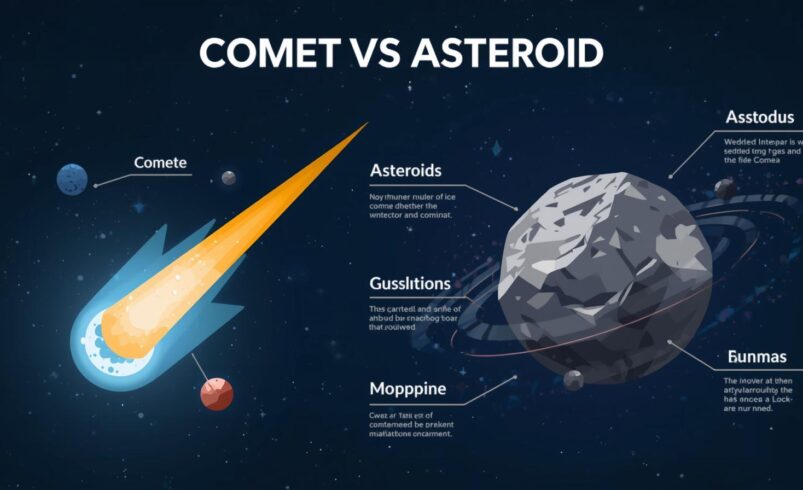
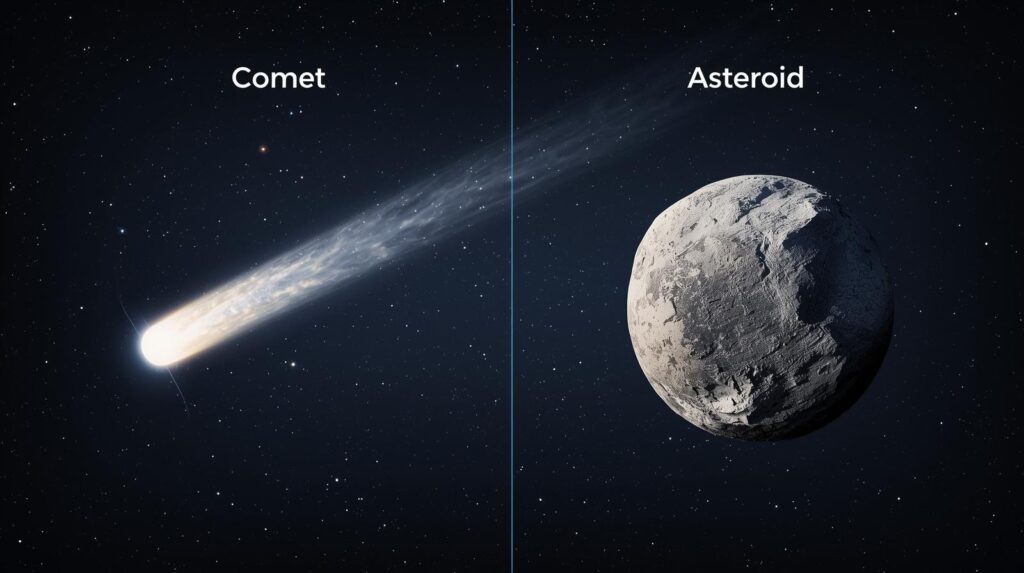
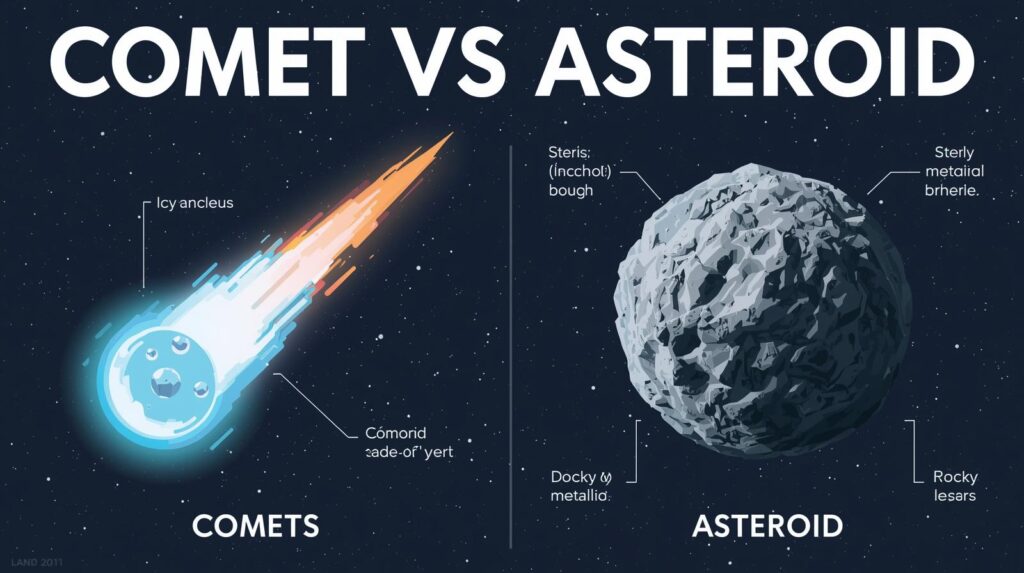
The fundamental difference in the comet vs asteroid debate lies in their composition. While asteroids consist primarily of rocky and metallic materials, comets are essentially cosmic snowballs composed of ice, dust, and rocky particles. This compositional difference creates the most visible distinction between these space objects.
When a comet approaches the Sun, its icy surface begins to sublimate, creating a spectacular glowing atmosphere called a coma and often producing a magnificent tail that can stretch millions of kilometers. Asteroids, lacking this volatile ice content, remain relatively unchanged as they orbit, appearing as solid rocky bodies even when close to our star.
The Origins: Where Do They Come From?
Understanding the comet vs asteroid origins reveals why these objects differ so dramatically. Asteroids formed approximately 4.6 billion years ago in the warmer inner regions of our solar system, where temperatures were too high for ice to remain solid. Most asteroids now reside in the asteroid belt between Mars and Jupiter.
Comets, conversely, originated in the frigid outer reaches of our solar system. Most comets come from two primary regions: the Kuiper Belt beyond Neptune’s orbit, and the distant Oort Cloud, which may extend up to 20 trillion kilometers from the Sun. These deep-freeze environments preserved the icy composition that defines comets.
Orbital Patterns: How They Travel Through Space
The orbital characteristics further distinguish the comet vs asteroid comparison. Asteroids typically follow shorter, more circular orbits that keep them relatively close to the Sun. Their paths are predictable and generally remain within the inner solar system.
Comets, however, often travel in highly elongated, eccentric orbits. Short-period comets complete their journeys around the Sun in less than 200 years, while long-period comets may take millions of years to complete a single orbit. Some comets travel so far into the outer solar system that passing stars can actually perturb their trajectories, sending them plunging back toward the inner planets.
Current Statistics: What NASA Is Tracking in 2026
The latest data from NASA’s planetary defense efforts reveals sobering numbers about the comet vs asteroid populations near Earth. As of August 2025, astronomers have identified 38,893 near-Earth asteroids, with 874 measuring over one kilometer in diameter and 11,373 exceeding 140 meters in width.
The tracking efforts have intensified dramatically. Scientists now discover approximately 40 new asteroids every week, and NASA reports that about 2,465 asteroids are currently classified as potentially hazardous objects (PHAs). The good news? More than 90% of near-Earth objects larger than one kilometer have already been discovered, significantly reducing the risk of a surprise catastrophic impact.
Regarding comets, the numbers tell a different story. Near-Earth comets comprise only about 0.33% of tracked near-Earth objects (just 123 compared to 37,255 asteroids). However, their unpredictable nature and high velocities make them particularly challenging to monitor.
| Category | Count (2025) | Size Threshold | Discovery Rate |
|---|---|---|---|
| Total NEAs (Near-Earth Asteroids) | 38,893 | All sizes | ~40/week |
| Large NEAs | 874 | > 1 km | 90%+ discovered |
| Medium NEAs | 11,373 | > 140 m | ~14,000 remain undiscovered |
| PHAs (Potentially Hazardous Asteroids) | 2,465 | > 140 m + close approach | Ongoing monitoring |
| Near-Earth Comets | 123 | Varies | Unpredictable |
Composition: The Building Blocks of Space Rocks
Diving deeper into the comet vs asteroid composition reveals fascinating complexity. Asteroids consist predominantly of silicate rocks and metals like iron and nickel. Different asteroid types show varying compositions some are carbonaceous (carbon-rich), others are metallic, and many are stony.
Comets present a far more diverse makeup. The European Space Agency’s Rosetta mission to comet 67P/Churyumov-Gerasimenko discovered that approximately 45% of escaping dust grains consisted of carbon-based organic molecules, including proteins and carbohydrates. The remaining 55% comprised inorganic minerals, mostly silicates. This organic material has led scientists to theorize that comets may have delivered the building blocks of life to early Earth.
Notable Recent Encounters: 2024-2025
The period between 2024 and 2025 witnessed several significant events in the comet vs asteroid narrative. In January 2025, Comet C/2024 G3 (ATLAS) became the “Great Comet of 2025,” reaching first magnitude brightness with a visible tail extending 20 arcminutes. This dynamically old comet, which had approached the Sun before, demonstrated the spectacular displays comets can produce.
On the asteroid front, 2024 YR4 captured global attention. Initially estimated to have a 3.1% chance of impacting Earth on December 22, 2032, this “city killer” asteroid sparked the first-ever Potential Asteroid Impact Notification from the International Asteroid Warning Network (IAWN). Subsequent observations and analysis by the James Webb Space Telescope eventually ruled it out as a significant impact risk, demonstrating how asteroid tracking systems work effectively.
In September 2025, asteroid 2025 QV5 approximately 35 feet across made a close approach to Earth, traveling at over 13,900 mph. It won’t return to such proximity until September 4, 2125, precisely 100 years later.
The Threat Assessment: Should We Worry?
When examining the comet vs asteroid danger potential, both pose unique threats. Asteroids are more numerous near Earth and therefore more likely to impact our planet. The 2013 Chelyabinsk meteor explosion over Russia, which released energy equivalent to 440,000 tons of TNT and injured hundreds through shock waves and broken glass, demonstrated that even relatively small asteroids can cause significant localized damage.
Comets, while less common as Earth-impactors, travel at much higher velocities due to their elongated orbits. A comet impact would release substantially more kinetic energy than an asteroid of similar size. However, their rarity and the advance warning provided by their distinctive appearance give scientists more time to prepare.
NASA’s Center for Near-Earth Object Studies (CNEOS) confirms that no large asteroid capable of causing widespread destruction is expected to hit Earth for at least the next 100 years. The agency evaluates potential threats using the Torino Scale, which ranges from 0 (no risk) to 10 (a certain, catastrophic impact). Recently, asteroid 2024 YR4 briefly reached a level 3 rating the highest since Apophis in 2004 before being downgraded as additional observational data refined its trajectory.
Hybrid Objects: Blurring the Lines
Interestingly, some objects challenge the traditional comet vs asteroid classification. Scientists have identified “active asteroids” or “main-belt comets” objects with asteroid-like orbits that unexpectedly develop comet-like tails. For instance, asteroid 311P/PANSTARRS, observed by the Hubble Space Telescope, displays six distinct tails while orbiting within the asteroid belt.
The asteroid 3200 Phaethon presents another puzzle. While classified as an asteroid, it produces a visible tail when approaching the Sun, behavior typically associated with comets. Additionally, the recent discovery of “dark comets” objects that show non-gravitational acceleration without visible tails further complicates the comet vs asteroid distinction.
These hybrid objects suggest that comets and asteroids exist on a continuum rather than as completely separate categories. Some astronomers theorize that comets may eventually become asteroids after their volatile ices fully sublimate during repeated passes near the Sun.
Detection and Tracking Technologies
Modern asteroid and comet detection represents a triumph of technology and international cooperation. The Asteroid Terrestrial-impact Last Alert System (ATLAS) operates four telescopes that continuously scan the sky, capturing 100-megapixel images throughout the night. When ATLAS discovered asteroid 2024 YR4, it demonstrated the system’s capability to identify potential threats months or years before closest approach.
The newly operational Vera C. Rubin Observatory revolutionizes comet vs asteroid discovery. In just 10 hours of operation, it detected over 2,000 previously unknown asteroids, including seven near-Earth objects. Over its planned 10-year survey, simulations predict it will identify approximately 127,000 near-Earth objects, dramatically increasing our catalog of tracked space rocks.
NASA’s upcoming NEO Surveyor mission, scheduled to launch between September 2027 and June 2028, aims to find two-thirds of near-Earth asteroids larger than 140 meters within five years of operation. Within 10 years, it should detect 90% of potentially hazardous asteroids in this size range.
Planetary Defense: Preparing for Impact
The comet vs asteroid threat has prompted serious planetary defense initiatives. NASA’s Double Asteroid Redirection Test (DART) mission successfully demonstrated that humanity can alter an asteroid’s trajectory. In September 2022, DART deliberately crashed into Dimorphos, a small moon orbiting the asteroid Didymos, changing its orbital period by several minutes.
For asteroids, deflection strategies depend on advance warning and the object’s characteristics. Kinetic impactors like DART work well for solid asteroids but might be less effective against “rubble pile” asteroids held together loosely by gravity. Other proposed methods include gravity tractors, nuclear deflection, and focused solar radiation.
Comets present unique challenges for planetary defense. Their unpredictable outgassing can alter trajectories unexpectedly, and their high velocities require earlier intervention. Fortunately, the long-period comets most likely to threaten Earth can typically be detected years or decades before potential impact, providing substantial preparation time.
Personal Perspective: Why This Matters
Throughout my years studying astronomy and writing for Ninty2Magazine, I’ve realized that understanding the comet vs asteroid distinction connects us to our cosmic origins. These objects are time capsules, preserving materials from our solar system’s birth 4.6 billion years ago. Every meteor shower reminds us that we’re intimately connected to these wandering rocks and ice.
When I take my children outside during the annual Perseid meteor shower caused by debris from Comet Swift-Tuttle I explain that they’re watching ancient comet dust burning up in our atmosphere. It’s a tangible connection to the comet vs asteroid story playing out across our solar system.
The Future of Comet and Asteroid Research
Looking ahead, our understanding of the comet vs asteroid dynamics will only deepen. Missions like Japan’s Hayabusa2, which returned samples from asteroid Ryugu, and NASA’s OSIRIS-REx, which collected material from asteroid Bennu, are revolutionizing our knowledge of asteroid composition. These samples contain organic molecules and water-bearing minerals, suggesting asteroids may have contributed to Earth’s oceans and the emergence of life.
Future comet missions will similarly transform our understanding. The European Space Agency’s Comet Interceptor mission, scheduled for the late 2020s, will visit a pristine comet from the Oort Cloud potentially an object making its first journey to the inner solar system. Such missions help us understand not just the comet vs asteroid differences, but also how these objects shaped planetary evolution throughout our solar system.
As technology advances, citizen scientists increasingly contribute to comet vs asteroid discovery. Amateur astronomers using personal telescopes and CCD cameras regularly discover new comets and asteroids, submitting their findings to the Minor Planet Center for verification. This democratization of space exploration means anyone with dedication and proper equipment can participate in planetary defense.
Exploring Further: Resources and Observation
For those interested in observing these cosmic visitors personally, several resources can help. NASA’s Eyes on Asteroids provides a real-time 3D visualization of every known near-Earth object, allowing users to explore their orbits and characteristics. The website tracks daily updates, making it an excellent educational tool for understanding the comet vs asteroid populations near our planet.
Amateur astronomers can contribute meaningful observations. The International Occultation Timing Association (IOTA) coordinates observers worldwide to measure asteroid sizes by timing how long they block distant stars a technique called occultation. These measurements help refine asteroid shape and size estimates, contributing valuable data to the global tracking network.
For comet hunting, dedicated astronomers use wide-field telescopes and sensitive cameras to scan regions of sky where comets typically appear. Organizations like the Central Bureau for Astronomical Telegrams coordinate comet discovery reports, ensuring new finds receive proper designation and tracking. Discovering a comet remains one of amateur astronomy’s most prestigious achievements, with comets named after their discoverers.
Looking at the Numbers: Discovery Progress
The comet vs asteroid discovery rate demonstrates humanity’s growing capability to monitor our cosmic neighborhood. Since 1990, astronomers have discovered and cataloged more than 33,000 near-Earth asteroids. The discovery rate continues accelerating what took decades in the 1990s now happens in months as detection technology improves.
Perhaps most impressively, only 10% of known near-Earth asteroids are currently well-characterized in terms of size, rotation, and spectral composition. At current characterization rates, it would take approximately 100 years to fully study all known asteroids. This gap between discovery and characterization presents both a challenge and an opportunity for future astronomical research.
The space research community estimates that approximately 14,000 near-Earth asteroids larger than 140 meters remain undiscovered. While this might sound alarming, it’s dramatically fewer than existed just two decades ago, representing tremendous progress in planetary defense preparedness.
Frequently Asked Questions About Comet vs Asteroid
Q: Can a comet become an asteroid or vice versa?
Yes, objects can transition between classifications. Comets that exhaust their volatile ices after repeated solar passes may become dormant and resemble asteroids. Conversely, some asteroids may harbor subsurface ice that becomes exposed through impacts or surface fractures, causing them to temporarily behave like comets. This transitional nature demonstrates that the comet vs asteroid boundary isn’t always clear-cut.
Q: Which is more dangerous to Earth a comet or an asteroid?
Asteroids pose a higher statistical risk because they’re more numerous near Earth. However, individual comets can be more dangerous due to their higher impact velocities. A comet striking Earth would release substantially more energy than an asteroid of equivalent size. Fortunately, long-period comets that might threaten Earth can typically be detected years before potential impact, while the asteroid population is increasingly well-cataloged, reducing surprise threats.
Q: How many comets and asteroids enter Earth’s atmosphere daily?
Earth accumulates approximately 100 tons of dust-sized asteroid and comet fragments every single day. Most of these particles are microscopic and burn up harmlessly in the upper atmosphere. Larger objects capable of creating visible meteors or reaching the ground as meteorites are far less common perhaps a few dozen daily worldwide. City-killer-sized impacts (objects over 40 meters) occur roughly once per century.
Q: What was the largest comet or asteroid impact in recorded history?
The most powerful documented impact in modern times was the 1908 Tunguska event in Siberia, where an estimated 40-meter asteroid or comet fragment exploded in the atmosphere with a force of 10-15 megatons of TNT, flattening 2,000 square kilometers of forest. The largest impact in human history was the Chicxulub impactor 66 million years ago a 10-kilometer asteroid that caused the extinction of the dinosaurs and dramatically altered Earth’s climate for years.
Q: How do scientists track and predict comet vs asteroid orbits?
Astronomers track these objects through repeated observations measuring their positions against background stars. Using gravitational physics and powerful computers, they calculate orbital elements and predict future positions with remarkable accuracy. For newly discovered objects, initial orbital calculations carry greater uncertainty, but each additional observation refines predictions. Advanced radar observations from facilities like Arecibo (before its collapse) and Goldstone provide extremely precise distance measurements, dramatically improving orbital predictions.
Conclusion: Our Cosmic Neighbors Deserve Respect and Study
The distinction between comets and asteroids is far more than an academic detail—it reflects our expanding understanding of how the solar system formed, what planetary defense requires, and where humanity fits within the cosmic landscape. As detection technologies improve and global cooperation strengthens, we’re better equipped than ever to identify, track, and respond to potential threats from these ancient celestial travelers.
Every time you see a meteor streak across the night sky, you’re witnessing the comet-versus-asteroid story unfold in real time. That brief flash is a piece of cosmic material unchanged since the birth of our solar system meeting its fiery end in Earth’s protective atmosphere. These moments remind us that we live in a dynamic environment where celestial objects interact constantly, sometimes posing risks but always inspiring awe.
With NASA now tracking nearly 40,000 near-Earth asteroids and advanced observatories scanning the skies around the clock, we’ve entered an unprecedented era of planetary awareness. What was once a theoretical scientific debate has become a practical necessity, driving innovation, global monitoring networks, and international collaboration.
So, the next time someone asks you about the difference between comets and asteroids, remember that it’s not just about ice versus rock it’s about understanding our cosmic neighborhood and safeguarding our planet. After all, we’re all temporary residents on this small blue world, sharing space with countless wandering rocks and frozen wanderers drifting through the void.