When I first looked up at the night sky as a child, I wondered: are those twinkling lights part of our solar system, or something far greater? That question sparked a lifelong fascination with space. Today, understanding the distinction between a solar system vs galaxy isn’t just academic it’s fundamental to grasping our place in the universe.
Many people use these terms interchangeably, but they represent vastly different cosmic structures. A solar system is a gravitationally bound collection of celestial bodies orbiting a star, while a galaxy is an immense assembly of billions of stars, gas, dust, and dark matter. Let’s explore these cosmic giants and understand what sets them apart.
What Defines a Solar System?
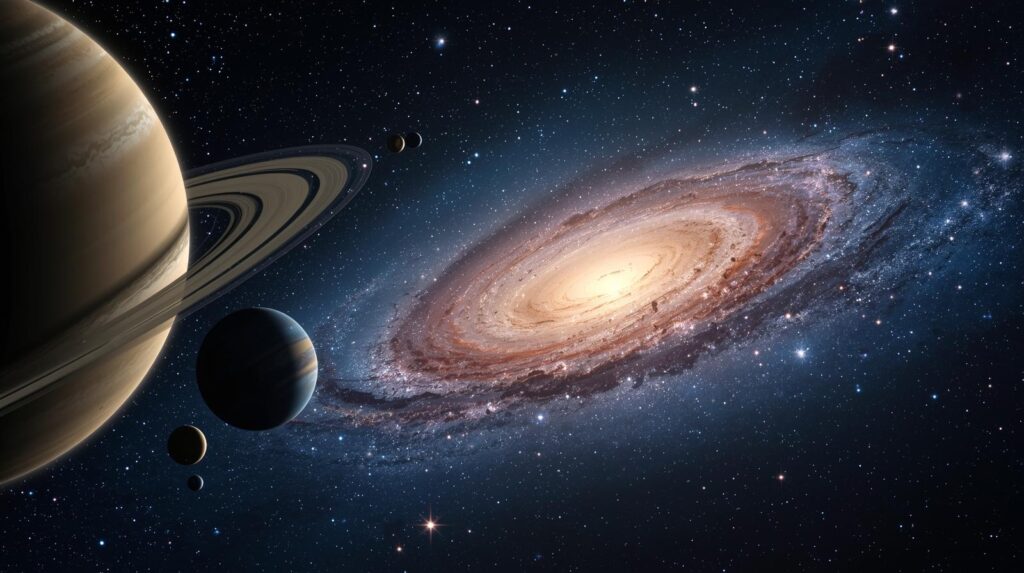
A solar system forms when a star, like our Sun, holds planets, moons, asteroids, and comets in its gravitational embrace. Our own solar system contains eight planets, over 200 moons, and countless smaller objects all orbiting within approximately 4.5 billion kilometers from the Sun.
The term “solar system” specifically refers to systems with a sun-like star, though astronomers also study planetary systems around other types of stars. These systems form from collapsing clouds of gas and dust, a process that takes millions of years.
Components of Our Solar System
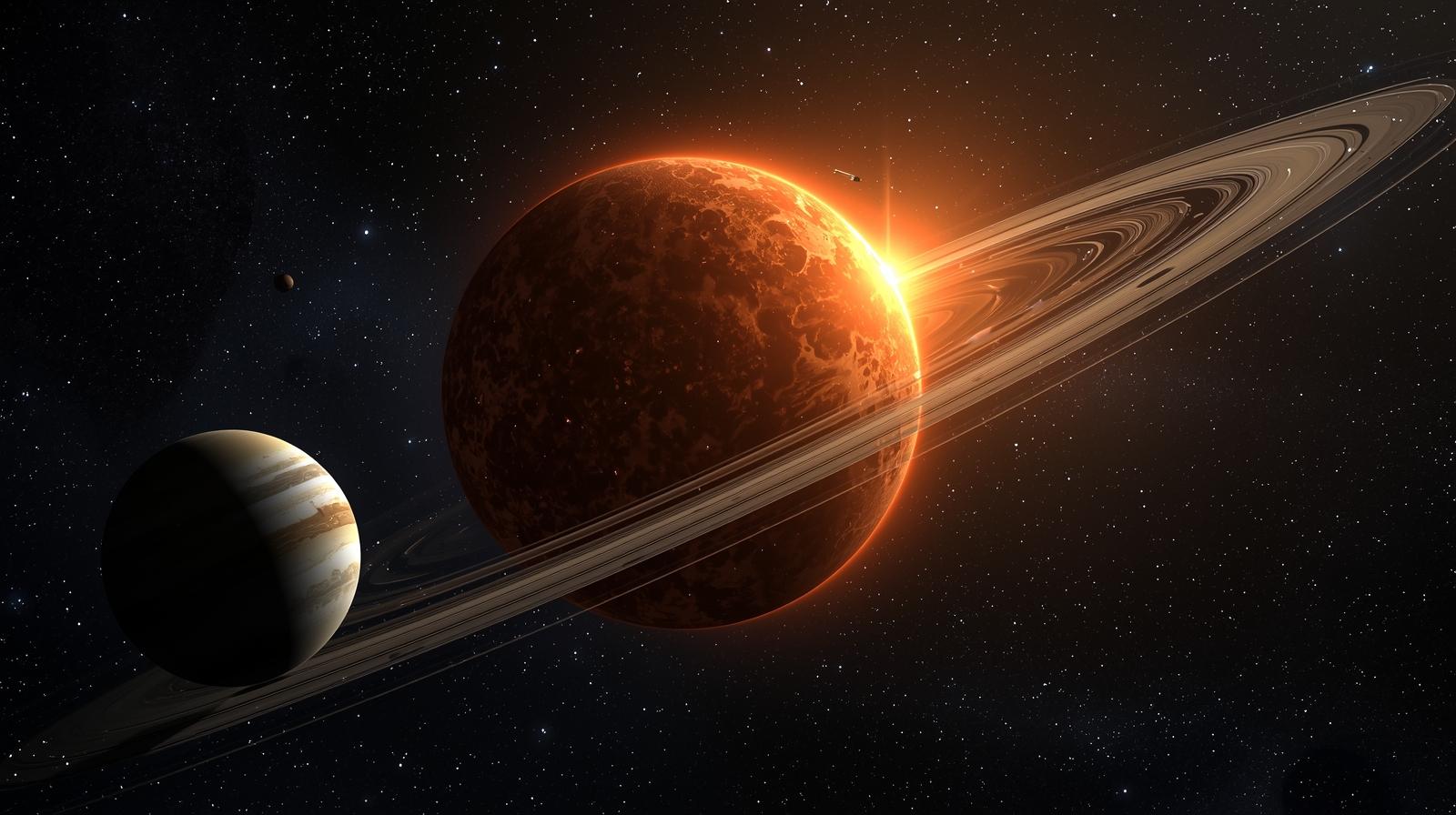
Our solar system includes distinct zones: the inner rocky planets (Mercury, Venus, Earth, Mars), the asteroid belt, the outer gas giants (Jupiter, Saturn, Uranus, Neptune), and the distant Kuiper Belt. Beyond that lies the Oort Cloud, a theoretical sphere of icy objects extending nearly a light-year from the Sun.
When comparing solar system vs galaxy structures, the scale difference becomes immediately apparent. While our solar system spans roughly 100,000 astronomical units (including the Oort Cloud), that’s minuscule compared to galactic dimensions.
Understanding Galaxies: Cosmic Cities of Stars
A galaxy represents one of the universe’s largest structures a massive collection of stars, stellar remnants, interstellar gas, dust, and dark matter bound together by gravity. Galaxies contain anywhere from millions to trillions of stars, each potentially hosting its own planetary system.
The Milky Way, our home galaxy, contains an estimated 100-400 billion stars according to recent astronomical surveys. That means our galaxy holds hundreds of billions of solar systems, making the solar system and galaxy relationship one of part to whole.
Types of Galaxies
Astronomers classify galaxies into three main types: spiral galaxies (like the Milky Way), elliptical galaxies, and irregular galaxies. Each type has distinct characteristics in shape, star formation rates, and composition.
The solar system or galaxy distinction becomes clearer when we consider that entire galaxies can collide and merge an event involving hundreds of billions of stars and their accompanying systems.
Solar System vs Galaxy: Size Comparison
| Feature | Solar System | Galaxy (Milky Way) |
|---|---|---|
| Diameter | ~100,000 AU (Oort Cloud) | ~100,000 light-years |
| Number of Stars | 1 (the Sun) | 100-400 billion |
| Mass | ~1 solar mass (mostly Sun) | ~1.5 trillion solar masses |
| Age | ~4.6 billion years | ~13.6 billion years |
| Travel Time Across (at light speed) | ~1.5 years | ~100,000 years |
This table illustrates the staggering difference in the solar system vs galaxy comparison. A single light-year equals about 63,241 astronomical units, meaning our galaxy is roughly 63 billion times wider than our solar system.
How Many Solar Systems Exist in a Galaxy?
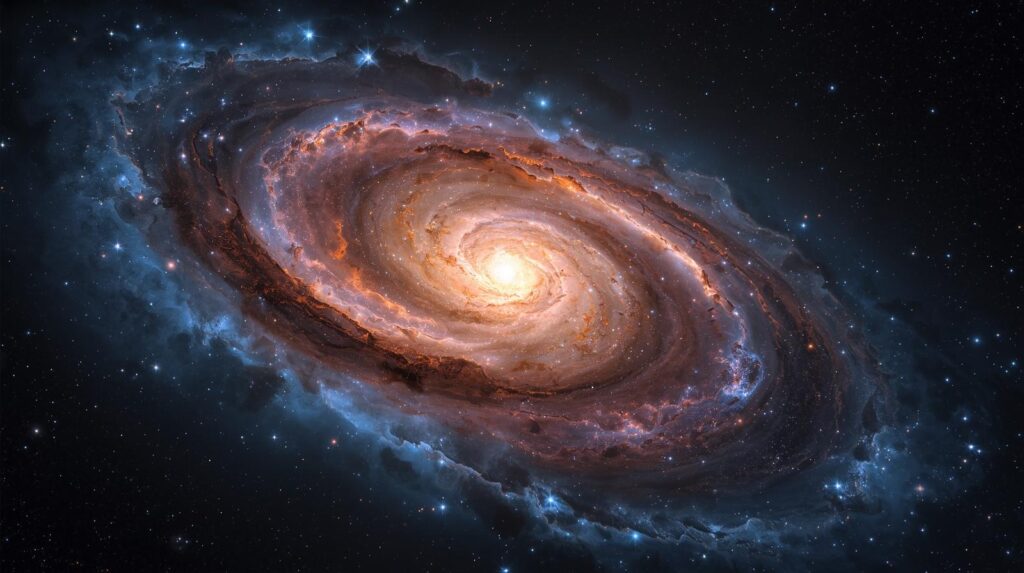
The question of solar system vs galaxy numbers reveals fascinating statistics. Astronomers estimate that most stars in the Milky Way host at least one planet, meaning our galaxy contains potentially 100 billion or more planetary systems.
Recent data from NASA’s Kepler mission and other exoplanet surveys suggest that planetary systems are the norm rather than the exception. This means when we discuss solar system and galaxy relationships, we’re talking about billions of individual systems within a single galaxy.
Our Solar System’s Position in the Milky Way
Our solar system resides in the Orion Arm, a minor spiral arm about 26,000 light-years from the galactic center. We orbit the galaxy’s core at approximately 828,000 kilometers per hour, completing one galactic year a full orbit every 225-250 million years.
This perspective shift is humbling. When considering solar system vs galaxy dynamics, we realize our entire planetary system is just one tiny speck in a vast cosmic wheel, itself one galaxy among billions in the observable universe.
Formation and Evolution Differences
The formation processes for a solar system or galaxy differ dramatically in scale and timeline. Galaxies formed within the first billion years after the Big Bang, approximately 13.8 billion years ago. These early galaxies were smaller and gradually merged to form the massive structures we observe today.
In contrast, solar systems form continuously within galaxies. Our solar system formed roughly 4.6 billion years ago from a collapsing molecular cloud, triggered perhaps by a nearby supernova shockwave. This process occurs throughout galaxies, with new stars and planetary systems being born in stellar nurseries like the Orion Nebula.
Personal Insight on Cosmic Perspective
Standing beneath a dark sky far from city lights, I’ve often contemplated how the solar system vs galaxy distinction changes our perspective. Every visible star is within our galaxy, yet each represents a potential solar system. The Andromeda Galaxy, our nearest large galactic neighbor, appears as a faint smudge yet contains a trillion stars. This scale fundamentally challenges our everyday perception of distance and size.
The Role of Dark Matter
When examining solar system vs galaxy composition, dark matter becomes a critical factor. While dark matter has negligible influence on solar system dynamics, it comprises approximately 85% of a galaxy’s total mass. This invisible substance provides the gravitational scaffolding that holds galaxies together and influences their rotation curves.
Researchers at institutions like the European Space Agency continue studying dark matter’s role in galaxy formation and evolution. This remains one of astronomy’s greatest mysteries, with implications for understanding both individual galaxies and the universe’s large-scale structure.
Observable Differences in the Night Sky
Understanding the solar system and galaxy distinction enhances stargazing experiences. Planets in our solar system appear as bright, steady points of light that move against the background stars over days and weeks. They don’t twinkle because they’re close enough to appear as disks rather than points to our atmosphere.
Stars, which belong to our galaxy beyond our solar system, appear as twinkling points because they’re effectively point sources of light affected by atmospheric turbulence. The Milky Way itself appears as a luminous band across dark skies our edge-on view of our galaxy’s disk from within.
Galactic Habitable Zones
Just as solar systems have habitable zones where liquid water can exist on planetary surfaces, galaxies possess galactic habitable zones. These are regions where solar systems are more likely to host life far enough from the violent galactic core but close enough to have sufficient heavy elements for planet formation.
Our solar system resides within the Milky Way’s galactic habitable zone, neither too close to the center (where radiation and gravitational disruptions threaten stability) nor too far out (where heavy elements are scarce). This optimal positioning may have been crucial for Earth’s development of complex life.
Future of Solar Systems and Galaxies
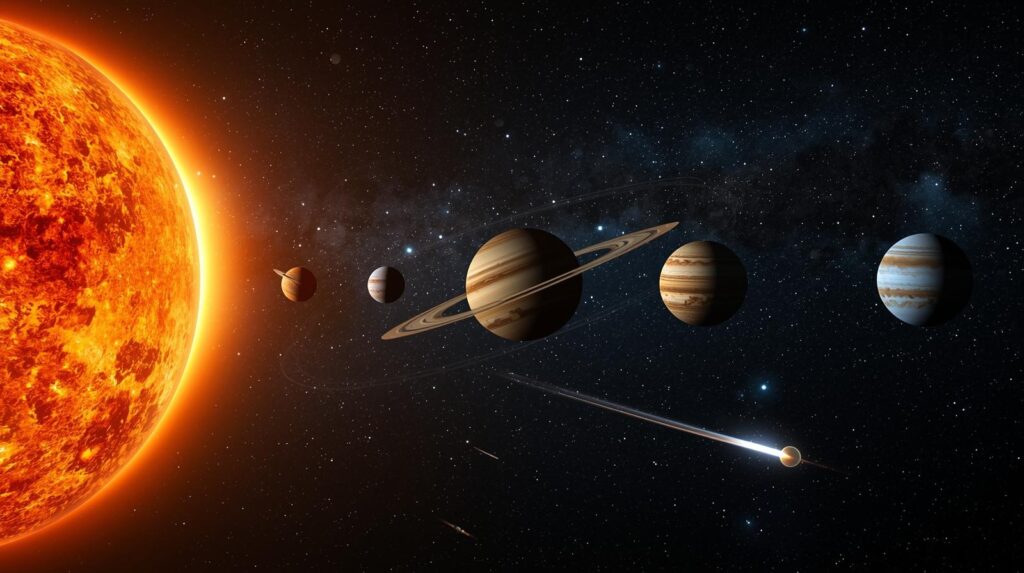
The solar system vs galaxy comparison extends into deep time. Our solar system will exist for another 5 billion years until the Sun becomes a red giant, ultimately ending as a white dwarf. However, the Milky Way has a far longer future.
In approximately 4.5 billion years, the Milky Way will collide with the Andromeda Galaxy, forming a new elliptical galaxy astronomers have nicknamed “Milkomeda.” During this merger, individual solar systems including potentially our own will likely pass through unscathed due to the vast distances between stars, though their orbital paths will change dramatically.
Scientific Significance and Research
Understanding the solar system or galaxy distinction drives different research approaches. Solar system science focuses on detailed study of nearby objects, sample return missions, and in-situ measurements. We’ve sent probes to every planet and landed on multiple moons, asteroids, and comets.
Galactic astronomy, conversely, relies almost entirely on remote observation across vast distances. Astronomers use spectroscopy, radio telescopes, and space-based observatories to study galactic structure, star formation, and evolution. The James Webb Space Telescope now reveals galaxies formed when the universe was just a few hundred million years old.
According to data from astronomical surveys, there are at least 200 billion galaxies in the observable universe, each potentially containing billions of solar systems. This means the total number of planetary systems in the universe reaches incomprehensible numbers perhaps 10^24 or more.
Educational Importance
Teaching the solar system vs galaxy distinction helps students grasp fundamental cosmic scales. Many educational programs, including those at Ninty2magazine, emphasize this difference as foundational to astronomical literacy.
This understanding also connects to broader science education, from physics and chemistry to biology and Earth science. Recognizing our position within nested cosmic structures planet, solar system, galaxy, universe provides context for countless scientific disciplines.
Conclusion
The distinction between a solar system vs galaxy represents one of astronomy’s most fundamental concepts. While a solar system is a single star with its orbiting planets and other objects, a galaxy is a gravitationally bound assembly of billions of stars, gas, dust, and dark matter spanning thousands of light-years.
Understanding this difference reveals our cosmic address: we live on Earth, the third planet in a solar system orbiting an average star, located in a minor arm of a spiral galaxy containing hundreds of billions of other stars, which itself is just one galaxy among billions in the observable universe.
This perspective simultaneously humbles and inspires. The solar system and galaxy relationship reminds us of both our insignificance and our uniqueness we’re a tiny part of an incomprehensibly vast cosmos, yet we’re the part that can look up, wonder, and understand.
Frequently Asked Questions
Q: How many solar systems fit inside a galaxy?
A: A typical galaxy like the Milky Way contains 100-400 billion stars, and since most stars host planetary systems, there are potentially hundreds of billions of solar systems within a single galaxy.
Q: Can a solar system exist outside a galaxy?
A: Yes, “rogue” or intergalactic stars with planetary systems can exist between galaxies, though they’re rare. These systems were likely ejected during galactic collisions or close encounters between stars.
Q: Is the Milky Way the only galaxy that contains our solar system?
A: Yes, our solar system exists within the Milky Way galaxy. We cannot be part of multiple galaxies, though in about 4.5 billion years, the Milky Way will merge with Andromeda Galaxy, placing our solar system in the resulting merged galaxy.
Q: What’s bigger: a solar system or a galaxy?
A: Galaxies are vastly larger. Our solar system spans roughly 100,000 AU (including the Oort Cloud), while the Milky Way galaxy spans about 100,000 light-years making it approximately 63 billion times wider.
Q: How does understanding solar system vs galaxy help us search for extraterrestrial life?
A: Recognizing that galaxies contain billions of solar systems expands the potential locations for life enormously. If even a tiny fraction of solar systems in our galaxy harbor life, the numbers become staggering so doesn’t that make you wonder what’s out there waiting to be discovered?